
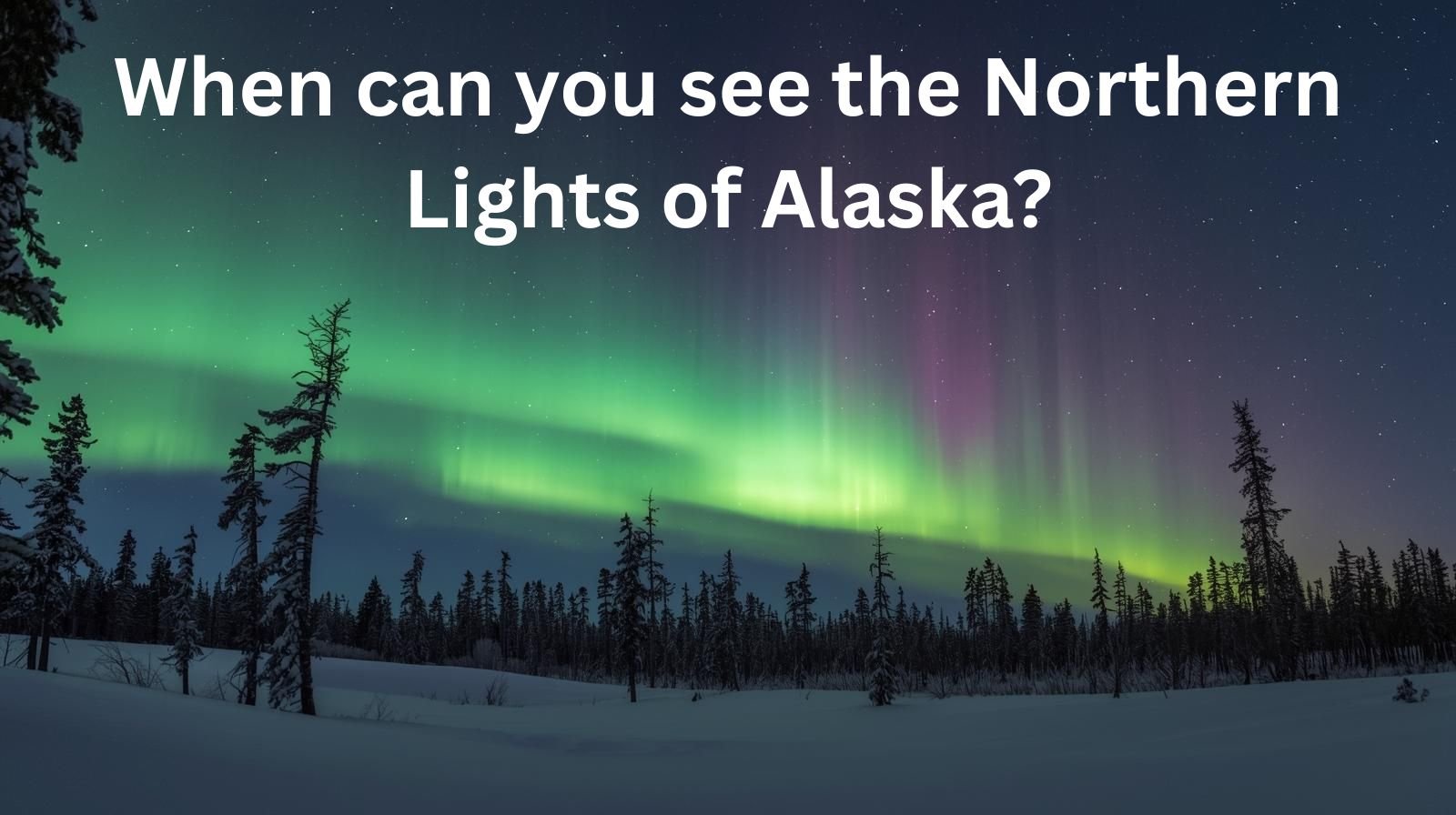
Many people have the aurora borealis on their bucket list. The aurora borealis is a celestial dance of greens, violets, and even sometimes reds dancing across the black canvas of night. My first experience is still vivid in my mind. It happened as I stood on a frozen pond outside Fairbanks. The cold was biting my cheeks. The sky became alive with light as a faint green ribbon slowly twisted and grew brighter. Only the gasps from my fellow travelers broke the silence in the Alaskan wilderness. This is a moment that will make you feel small and connected with the universe at the same time. Alaska’s vast dark skies and its prime location beneath the “Auroral Oval” make it the ideal place to see this spectacular show in the United States. Timing is key. Understanding when, where, and how to search for the aurora is essential to planning a trip. This guide was created from research and personal experience to help plan an unforgettable Alaskan trip.
What Are the Northern Lights: Understanding the Aurora?
It is important to know what they are before we can discuss the best time to view them. This incredible light show is the product of a massive interaction between cosmic forces. Solar wind is a constant stream of charged particles that the sun constantly emits. The magnetic field of our planet directs these particles towards the poles when they travel 93 million miles from the sun to Earth. When they reach our upper atmosphere, they collide and interact with molecules and atoms of gas, primarily oxygen and nitrogen. These collisions cause the gas particles to glow. This is similar to the way a neon light works, only on a larger scale. The colors you see are determined by the gas being excited at each altitude. Oxygen atoms produce the most common color of brilliant green at altitudes between 60 and 150 miles. Red auroras are rarer and occur at higher altitudes. Collisions with nitrogen particles can cause pinks, purples, and blues. The celestial event occurs constantly, but only under certain conditions can we see it.
Aurora Season is Here in Alaska
When is the best time of year to plan your trip? Alaska’s prime viewing period for northern lights is from late August until late April. Locals refer to these eight months as the “Aurora Season.” Darkness is the key to seeing the lights. Alaska is a place where the Midnight Sun phenomenon occurs during the summer months. This happens from late April to most of August. Even in the southern cities of Anchorage and the far north, where the sun doesn’t set for weeks on end, there is only a brief period of darkness. Even if the aurora is active, it’s impossible to see it with this constant daylight. The night sky will darken as the days get shorter in late August. Season continues throughout the winter’s long dark nights and into the early spring. The lights finally fade as the Midnight Sun returns. This entire period is a great time to enjoy the lights. However, there are certain months that offer distinct benefits for travelers.
Viewing Times by Month
The Aurora Season is open to all, but the experience can vary from one month to the next. What you prefer might depend on the other activities that you plan to do and the weather conditions you are prepared for. The shoulder months, as well as the deep winter, have each their own charm.
You can still hunt for the auroras in milder weather from late August to September. The temperatures at night can be quite comfortable, and you don’t have to wear the heavy winter gear that is required in January. You can combine the aurora with activities such as hiking, fishing, or other late summer activities. This is a time when the landscape has no snow, and the aurora lights can be seen in a beautiful, different way.
October and November are months of transition. Temperatures drop, and snow starts to fall in the Interior and Arctic Regions. Tourist crowds also thin out. It can be an ideal time to enjoy a more intimate, quieter experience. As the nights grow longer, your viewing area increases each day.
Darkness is at its peak in December, January, and February. In some areas, the nights can be as long as 18-20 hours. Alaska is what many people imagine: a snow-covered winter wonderland. The snow isn’t just beautiful, it also reflects the auroral lights and makes the landscape glow. This is the coldest part of the year. In Fairbanks and in the Arctic, temperatures can drop to as low as -20degF or even lower. The cold is intense, but it’s a great time to enjoy classic winter activities such as dog sledding and snowmobiling.
Many, including me, consider March and early April to be the best time. While the extreme cold of winter is beginning to fade, the long and dark nights still allow for some spectacular displays. During this time, the skies are often clearer than they were earlier in the season. The temperatures are also more comfortable. This is a popular period, because major winter events such as the Iditarod sled dog race also take place in March.
Aurora Borealis: Best Nighttime to View the Aurora
You need to know when to look up at night. Northern lights can be seen at any time in the darkness, but are usually most active between midnight and 2 am. It is called “aurora primetime.” This window is true from my own experiences of waiting. The evening often begins quietly with a sky filled with stars. Around 11 pm, a milky white arc may appear on the horizon. It is easy to mistake it for a cloud. This band may intensify over the next hour and begin to change color. Substorms are the most impressive, fast-moving displays. They usually peak at midnight or one a.m., but this is only a guideline. I’ve witnessed spectacular displays as early as 9 pm as well as as late as 4:00 am. Patience is the key. The aurora cannot be scheduled. You should find a good spot to sit, prepare your equipment, and wait. Many lodges provide a “wake-up call” service that will let you know if any lights are on, so you can sleep in without missing out.
Find the Auroral Oval
The location is as important as the timing. You need to be at the right location to maximize your chances. Scientists have identified a zone around Earth’s geomagnetic polarities called the Auroral Oval as the best place to view the aurora. This oval is perfectly draped over Alaska’s northern half.
The best places to view the aurora in Alaska:
- Fairbanks, Interior and Fairbanks: Fairbanks has been widely recognized as the most accessible and best place to view the aurora in Alaska. The city’s position under the Auroral Oval makes it a great place to see the aurora. There are many tours, viewing lodges, and heated cabins in the city. Its inland location also means that it has clearer nights on average than coastal areas. This is an important factor. Just 15-20 minutes of driving outside the city will allow you to find a dark, clear sky.
- The Arctic Region: Even for the most dedicated aurora hunters, going even further north into the Arctic Region offers an unmatched experience. Auroral Oval is a vast area that includes towns like Wiseman, Coldfoot, and the Dalton Highway. A near-total lack of light pollution, combined with the vast open landscapes, creates an immersive experience. This is an adventure that rewards you with the most intense and consistent aurora displays in the world.
- Talkeetna & Denali: Although not as far north as Fairbanks, areas around Talkeetna & Denali National Park offer excellent viewing opportunities. The areas are sufficiently north with minimal light pollution. Winter trips to this area can be peaceful and serene. The massive peaks of the Alaska Range provide a beautiful foreground in your aurora photographs. Although the chances are slightly lower than in Fairbanks, the scenery in this region is unmatched.
It is possible to view the aurora in Southcentral Alaska, including Anchorage, and sometimes in Southeast Alaska. However, it is not recommended that you plan a trip to Alaska if your main goal is to see the lights. The Auroral Oval is farther away from these regions, and the coastal weather patterns can often obscure the sky.
Aurora Chaser Tips for Maximizing Your Chances
Planning is key to increasing your odds of seeing the northern lights. Booking a trip of only one or even two nights is a common mistake. Clouds can ruin a trip in a hurry.
These tips will help you to win more:
- Stay Multiple Nights: Give yourself plenty of time. Plan on staying at least three to four nights in an area that is known for its aurora viewing, such as Fairbanks. Local tourism experts have found that those who spend three nights actively searching for the auroras are 90% more likely to see them. You increase your chances of seeing the aurora by adding an extra night.
- Stay away from city lights: Light Pollution is the enemy of viewing auroras. Even a little ambient light can reduce the intensity of the strongest displays. Take a trip to a location with a dark sky or book a lodge out of town. Find a parking lot or safe pullout with a view of the north if you’re driving.
- Watch the Aurora Forecast. Science gives you a heads-up. The University of Alaska Fairbanks Geophysical Institute offers a nightly forecast of auroras. The Kp-index predicts the level of geomagnetic activity on a scale of 0 to 9. A Kp value of 1 or 2 could indicate a faint glow low on the horizon, while a Kp of 4 or 5 might produce an impressive corona overhead. You can use the forecast to decide if it is worth staying up late one night.
Dressing for the occasion: staying warm is key.
If you’re freezing cold, the excitement of seeing northern lights will quickly diminish. Alaskan winter nights can be dangerous and uncomfortable if you are not prepared. There is no such thing a being too dressed up for an aurora hunting. Dress in layers to regulate your body temperature. Cotton can make you colder as it retains moisture. Choose wool or synthetic fabrics instead. Layering is best done with a base of thermal underwear, both top and bottom, a midlayer of down or fleece, and a windproof, insulated outer layer, such as a parka. Do not forget to bring insulated boots, warm hats, neck gaiters or scarves, and gloves or mittens of high quality. Some people bring hand and foot warmers that they can tuck in their pockets and boots. These small items will make a big difference if you are waiting for a long time in the cold.
Aurora Viewing and Other Alaskan Adventures
The northern lights are a great way to discover other Alaskan winter experiences. The majority of aurora viewing occurs late at night. This leaves you with plenty of time to explore. You can make your trip more memorable by adding incredible adventures to your itinerary in places like Fairbanks. You can experience the excitement and power of a husky team pulling you through the snowy forest on a dog-sledding trip. Try ice fishing, an Alaskan tradition. These activities are often combined in packages offered by tour operators. You can book a tour that includes an aurora view and another activity, such as a snowmobile ride at night or a soak in Chena Hot Springs. Imagine soaking in warm mineral-rich waters while watching the aurora dancing above you. It’s a truly unique experience.
Photographing the Moment: Some Words about Photography
The northern lights are a difficult but rewarding subject to photograph. You won’t get good results with your smartphone camera unless you have one that has a bright display or a newer model that is newer and offers a night mode. You’ll need to use a DSLR camera or a mirrorless camera with manual controls for the best results. As you will be using long exposures, a sturdy tripod is essential. For your camera settings, a wide aperture (such as f/2.8) is ideal. Also, ISO should be between 1600 and 3200, and shutter speed between 10 and 20 seconds is are good option. There are many photography tours where you can get expert help with your camera settings. Don’t let the fact that you don’t own a fancy camera stop you from enjoying your experience. Place your phone aside, look upwards, and enjoy the show. You will take the most precious souvenir home with you: the memory of the aurora dancing over you.




Leave a Reply